
Try Systems Thinking
CIO Journal


When computer programmer Thomas Anderson (under the hacker alias “Neo”) uncovered the truth, he joined a rebellion against the machines.
The computers had created a simulated reality to distract humans from the truth: they were using their bodies as an energy source. Morpheus, the head of the resistance, explained to Neo that the very people they were trying to rescue from the system were the ones trying to destroy them.
The 1999 cyberpunk sci-fi classic The Matrix captured this insight almost perfectly: the purpose behind a system isn’t always obvious. Reality is not what you see when you’re trapped inside a system. Why are things set up a certain way, and why do they do what they do? When you see the big picture - why the system exists - you’re better prepared to improve it. Or escape it, in Neo’s case.
That’s system thinking in a nutshell. I want to show you, data leader, the red pill: the mindset of a systems thinker.
People in your company are trapped in a matrix of processes and reports, all tied together by data. As a data leader, you can help them see the big picture with systems thinking. It will help you create better solutions, set better roadmaps, and think more holistically about your role and influence in your company.
Stocks, Flows, and Feedback Loops
Donella Meadows, one of America’s premier systems theorists, said, “Managers do not solve problems, they manage messes.”
Those “messes” - also known as systems - are all around you, in any set of connected parts that your company expects to produce a business result. Systems thinkers draw visual models to describe the mess, showing as many of the system’s complexities and interconnections as they can fit into their illustrations.
Take a bathtub, for example. The purpose of a bathtub is to help you relax and wash up. This system includes a tub, water, a faucet, and a drain, all working together to create a relaxing bath environment, as this image shows:
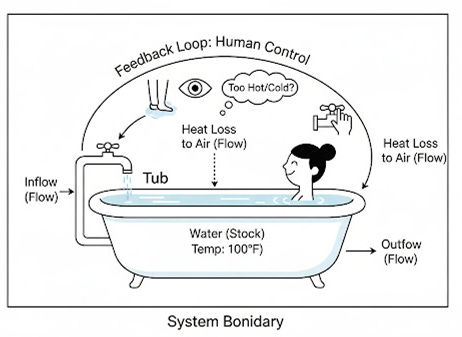
This illustration shows the three basic elements of a system:
Stocks - a good bath has a tubful of water at just the right temperature, let’s say 100 degrees Fahrenheit.
Flows - water enters the tub through the faucet at a specified volume and temperature. It flows out through the drain. Temperature also flows; it cools when the air outside the tub is cold.
Feedback loops - when you dip your toe in the water, you recognize if it’s too hot or cold, and you adjust the hot water valve. Some tubs (like a pool) may have a thermostat that makes these adjustments automatically.
Like this bathtub illustration (adapted from Meadows), everything we think we know about the world is a model that reveals our understanding of how things work.
Many interconnections in a system involve information flow, not just the movement of physical elements like water. Your purchasing system, for example, includes people, processes, and technologies that keep your factory running. Why does this system perform a three-way document match (order → receipt → invoice)? To keep you from paying for things twice or sending people money for things you never wanted.
A Data Leader’s Mindset
The CIO of a large public company called me after reading one of my articles and asked to meet. Upon arrival, I discovered I had only 15 minutes to share my entire approach to data management. How would I clearly and quickly explain my “frictionless” strategy?
“Does the term ‘system thinking’ mean anything to you?” I asked.
He smiled and explained that he was a mechanical engineer before becoming a CIO. My question helped him see the difference between my approach and the disconnected solutions that were causing his data challenges.
Why do you need systems thinking now? You might see yourself purely as a technologist, but that’s not really leadership. Good leaders see the big picture - why a system exists - and that’s especially important as you lead a data team. You see things others cannot: the entire system, the process flows, and the decisions that use and influence the data.
Morpheus knew this, and he warns you and me: “You have to understand, most people are not ready to be unplugged.”

To help remind you of these concepts, I’m now adding a hit 80s song to the Frictionless Data Spotify playlist each week. This week, enjoy Walk Like an Egyptian by The Bangles.
This is great. But what is a "bonidary"?