
Don’t Forget Investment Data
Using Lifecycle Thinking to Close the Executive Context Loop


Hey readers! Don’t forget to check out the Spotify playlist at the end of this article. Every Frictionless Decisions article includes a hit 80s New Wave song to help you remember the article’s theme. Let’s jump in!
You’ve built a good, standard data platform. You’ve responded quickly to requests for reports and data access. Why are the executives in your company still so unsatisfied with their data?
Here’s one possible answer: You’re ignoring their investment decisions.
Data teams don’t understand business decisions as much as they think they do. They understand business systems - ERP, MES, CRM, and many others - and these applications generate huge datasets. Obviously, people need help to make sense of that data, but investment decisions focus on the future, not past business transactions.
Most of the data people use for investment decisions is in people’s minds, not in those systems.
Decision Types
Take a look at all the reporting solutions your data team supports. Group them by the type of decisions they support. Try these three categories.
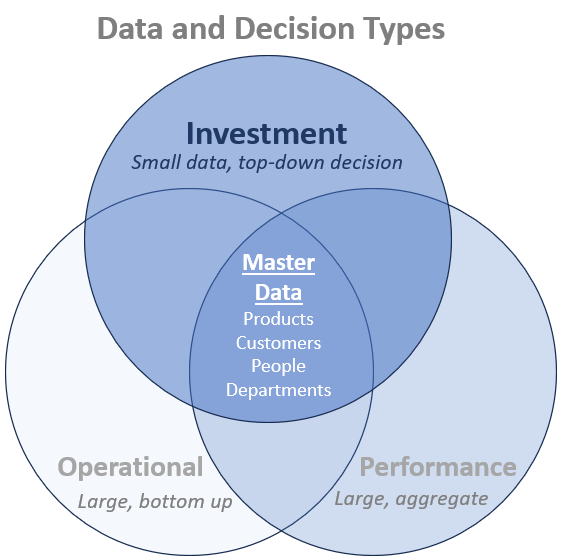
Operational. Operational reporting focuses on measuring a business process, like shipping products. For example, on-time delivery percentage measures the shipping process, and uptime percentage measures a system’s performance. These reports don’t measure the entire company, only a discrete operation. They’re not strategic.
Performance. Some reports measure overall company performance. An aggregate measure like book-to-bill ratio indicates a growing order backlog; you’ve received more orders than you shipped. They might make an investor feel more confident, but data comes from past activity. They don’t represent a strategic decision.
Investment. Investment data shows where time and money are going toward new business. Engineering development time, for example, indicates the new products or capabilities that your company is prioritizing. Sales opportunities show new customers for existing or new products. These datasets indicate real decisions about the future. They’re not your customer’s or your vendor’s decisions; your company’s employees make them. They show your company’s resources and capacities. They’re inputs to decisions, not just outputs from operations.
Where do you find this data? Investment decisions start at the top of your company. By the time a decision shows up as a business transaction, the strategy is already locked in. Data for the next investment decision is now in the executive’s mind. It’s probably also on their desktop.

Lifecycle Thinking
These decision-data categories mirror “product lifecycle” thinking. Famed Harvard economist Theodore Levitt popularized the model to help leaders think more strategically about their business. He saw that many companies unintentionally followed a one-and-done decision-making process; they created an innovative product, but failed to continue making decisions to extend the product’s life or replace it with the next generation. He saw four phases in the cycle:
Development: Defining a product and creating demand for it. The goal of this stage is to minimize product launch failures.
Growth: Successfully launching a new product invites competition. The goal of this stage is to establish brand preference and dominate the market with proactive positioning and pricing decisions.
Maturity: When a product has fully penetrated the market, strategy shifts to extending its life and defending its market position.
Decline. Technology changes, consumers get bored, margins shrink, and competition increases. The goal of this stage is to retain customers by proactively moving them to replacement products.
During the growth, maturity, and decline stages, business systems generate operational data. Performance metrics measure these phases. But strategic decisions are made almost entirely before those stages even begin.
That’s why this lifecycle framework is so helpful: it changes a decision-maker’s perspective. They stop focusing on past performance and consider the entire financial trajectory of their products, their broader purpose, and how innovation affects the curve. They ask different questions: Can you predict the lifecycles for a new product? Can you know what stage a product is currently in? Can you use this knowledge to your advantage?
Levitt said, “Leaders know the concept of lifecycle, but don’t know how to use it for advantage…at each stage in a product’s life cycle, each management decision must consider the competitive requirements of the next stage.”
Find the Hidden Data
One of the most common problems I hear from executives is that their IT teams don’t understand the business. Then I hear the opposite story from IT leaders; they think the business people haven’t done enough to explain their requirements. How does this disconnect go on so long and become so painful for a company that they need to call in a consultant?
Executives compare business data to their original plan, and that plan data probably doesn’t live in any of your business systems. Instead, it’s in a spreadsheet on their desktop. It might even be in a PowerPoint slide. But it lines up with the same basic structure as all the business execution data that will eventually show up in your ERP system. Capturing this plan-of-record data in your data platform suddenly creates the missing decision context they are looking for.
Connecting data to decisions doesn’t require you to keep up with the very latest data management technologies. Capturing all the data from your business systems won’t make the connection either. Even scouring the entire corpus of the internet and processing it in real time won’t make a difference. To connect data with decisions, you need to get into the mind of decision-makers and understand what they’re thinking about.
Capture that unseen data, and you’ve closed the context loop for executives. You’ve made the data for all the other phases more useful.

To remind you of this week’s data concept, enjoy Don’t Forget Me When I’m Gone, by Glass Tiger from the Frictionless Data Spotify playlist.